About — Jacob Kell
It started with a rent ledger.
A few years ago I took on a role at my family’s property company: bring the operation into the digital age. Rent was collected by bank deposit at a credit union and tracked on paper, and the owners were losing their days to it. My job was to build something better and take over collections myself.
I’ll be responsible for that company one day, so I approached the problem the way an owner would — not how do I get through this, but how should this work, permanently. That question got its hooks in me. I started with a spreadsheet script, then real code, and somewhere in there something lit up: I could imagine a feature in the morning and be using it that afternoon, in the actual work. I caught myself spending hours on it, obsessed with making it not just work but work well. I had never felt so eager to work in my life. I’d assumed this kind of thing was tedious technical labor. It turned out to be creative work — and it turned out I have an eye for the whole of a system, not just its parts.
The first thing I built that made me stop and stare was small. I’m not a natural at follow-up; I avoid it. But rent collection with tenants who are seldom on time can’t be avoided. So I asked what would make it easier — and built a tracker where anyone unpaid by the 6th surfaces as needs communication, with a note of their situation, an expected date, a follow-up reminder, and eventually a one-click text. Nothing fancy. But a job I dreaded had become a job the system carried, and I just supplied the human part. That is still the whole idea.
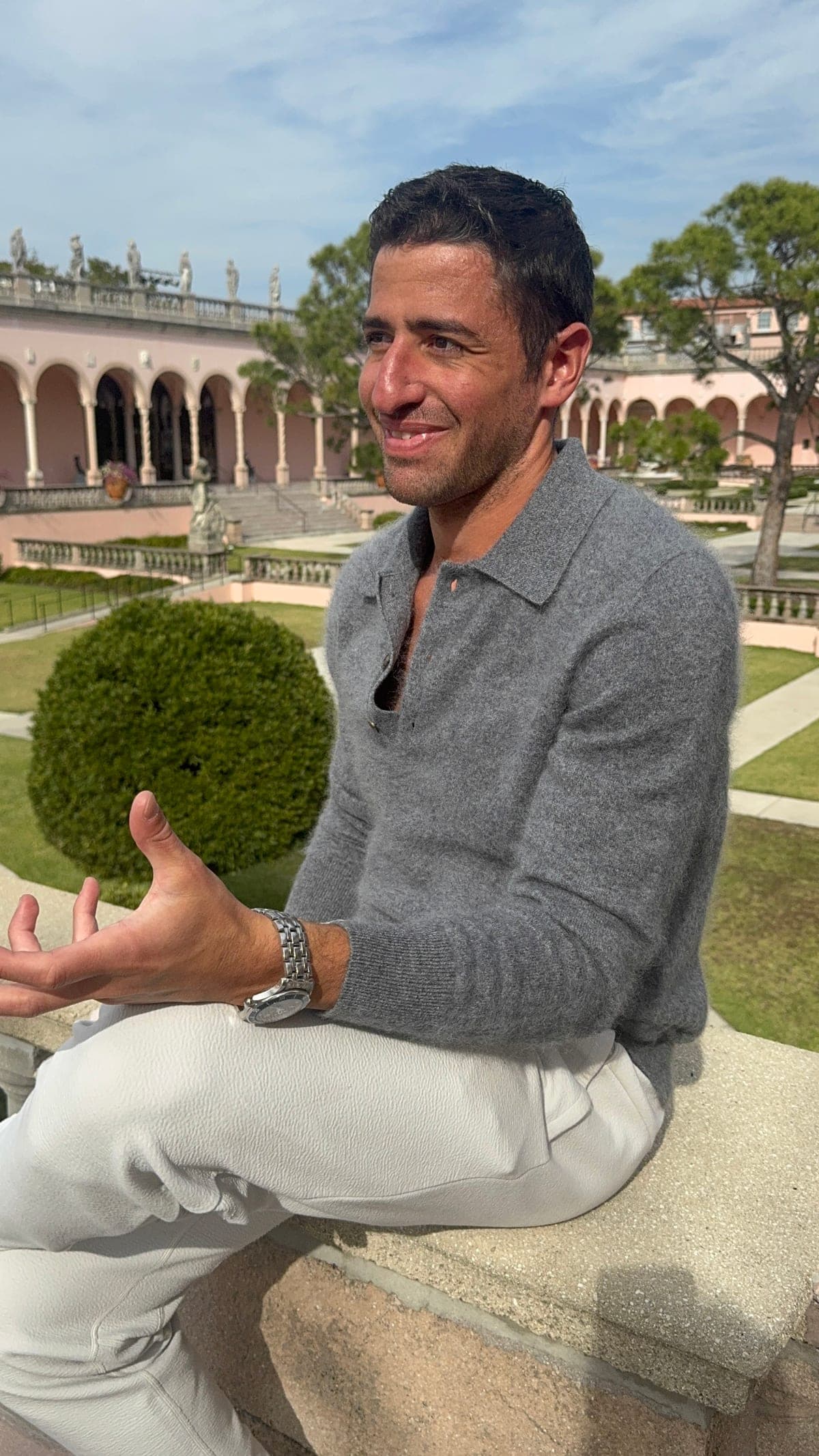
Where I’m from, and where I went
I grew up in Canton, Ohio, in a house where money wasn’t a worry — my father built a real estate business, and I had every advantage. I also wanted out. The world felt large and Canton felt small, and I was drawn to culture, food, history, old streets, thoughtful design, things made with care. So I studied international business and French in Charleston — still my favorite American city — and spent as much of it in France as I could: a semester with a host family in La Rochelle, a summer building show spaces for new luxury brands during Paris fashion week. Then a master’s in the marketing of luxury goods, in Monaco, in an apartment above the Mediterranean I’d fallen in love with as a kid.
And that’s where the important thing happened. I was exactly where I’d wanted to be, doing exactly the thing, and I felt restless and unfulfilled anyway. I made a decision that year: I would not arrive at fifty with all the trappings and still feel this way. Whatever was missing, I would find it — at all costs. That vow has run my life since.
What followed wasn’t glamorous. Years of not knowing how to turn a fancy education into a career. A luxury travel business that failed, because I hated selling. A move back home. And through it, the real work: study, a lot of it, into how people change from the inside — and then a partnership that tested every conclusion I’d reached. My partner and I are opposites in nearly every way, and learning to communicate across that meant something I’d never had to do: set down my own perspective, with my own feelings still running hot, and stand in hers until I could see what she saw. When I finally could, everything unlocked — for both of us. I learned that a working system between two people is built the same way: gather every perspective, assume your own picture is incomplete, stay open to being wrong, and the more parts you bring on board, the more clarity you live from.
That’s what lit up when I started building systems for a business. I could see how much was available if information were organized, made visible, and made to move — how much easier and more effective an operator’s day could be if the business were treated as a whole living thing, in relationship with the person running it. I came home to Canton thinking the world was elsewhere. It turned out this was the work, and it was here.
What I actually think a business is
Once you create a business, it becomes its own living thing. Not a person — but not a project either. An entity, with its own identity, its own needs and strengths and weak points, its own way it wants to move through the world. It starts inside you, as an idea. Then you build it, and at some point it moves outside you: a legal structure, materials, customers, a reputation. It has its own body now.
Most independent operators never make that distinction. They treat the business as themselves and themselves as the business — no boundary, no separate identity. It exhausts them, because every need the business has lands directly on them. And it holds the business back, because a thing never allowed its own identity can’t quite go find its own footing, its own customers, its own way of relating to the world.
So the first thing I do isn’t software. It’s getting to know two entities. The business: its personality, how it works, what it needs. And the operator: how you work, what you’re good at, what you avoid. The two are not the same, and a system that ignores either one fails. Then I build the thing that connects them — the fascia and veins of the business’s body, moving information so the whole organism moves as one.
The principles I build from
I’ve spent a long time studying how living things are organized — how people change from the inside, how systems hold together — and the same patterns keep proving true, in nature and in businesses.
Everything works the same at every scale. Every part belongs to a whole; every whole is a part of something larger. Clarity comes from seeing the system you're in and your role inside it — which is also how you see what to build.
Healthy systems communicate easily. Information has to be available and shareable without effort. In a business that means capturing the informational bloodstream — what's happening in every part of the body — so decisions get made with the whole picture instead of a corner of it. The more perspectives reporting in, the better the decision.
What doesn't flow, stagnates. If there's a part of your operation you don't flow with, you'll avoid it or force yourself through it — and forcing breeds resentment and puts a bad energy into the system. Better to find the way that part can flow for you. That's usually the exact piece worth building.
A business has needs, in an order — revenue, customers, something of real value to offer; then organization and clean information; then good decisions. Meet them and it flourishes: less pushing, less effort, more automatic doing. Chase value in the world instead of revenue, and the revenue follows.
Why not just buy the software
Plenty of platforms are useful; some are excellent, and for a great many people they’re the right answer. But every one of them was designed to serve many — and your business isn’t like every other business, and neither are you. You buy in believing in the time you’ll save. Months later you’ve found what it can’t do, won’t do, or won’t do the way you run, and you start adapting to it: extra steps, workarounds, friction. Everything you shaved off, you’ve added back. I know because it drove me up the wall. The technology is there to serve the operator, not the other way around.
How I work
I get to know things intimately. I care about details and quality more than speed or volume, and I’d rather take longer and get the right thing for the right person — that’s when work feels the way it should and the world is a little better for it. I stopped selling luxury a long time ago, but I never stopped studying what makes a thing worthy — the identity, the fit, the quality — and it shows up in every system I build.
The measure I hold myself to: a working system is one you use every day without thinking about it, the way you sign your name with your favorite pen. It should save you real time on work you’d have to do anyway. It should make the mundane require the least possible input from you — one click where there were six, information moving from A to B to C on its own, what you need to know sitting right beside you when you need it. And it should sharpen your decisions, because you can finally see through the brain of your own business.
I steward my family’s property holdings and a vacation rental; that’s where all of this was learned before it was ever offered to anyone. What I do for other operators is get to know their business as its own living thing — and build it something that liberates it to run to the beat of its own drum.
Operational systems, built from scratch around how your business actually runs — an extension of the hands that run it.
Built to subtract.